
No Brewster County 72-Hour Release Window
The official Brewster County Sheriff page offers the jail's contact information but no current roster or recent-release control. The county sitemap also contains no inmate search, booking page, 72-hour list, or broader recent-release search that can be filtered to three days.
As a result, Brewster County has no published cadence, no archive behavior, no web field list, and no online retention period for a three-day feed. An outside roster cannot fill that official gap. A definitive result must come from the jail, a county release or transfer document, and the court record when a legal disposition needs confirmation.
Review the official Brewster County sitemap to see the county services that are actually published.
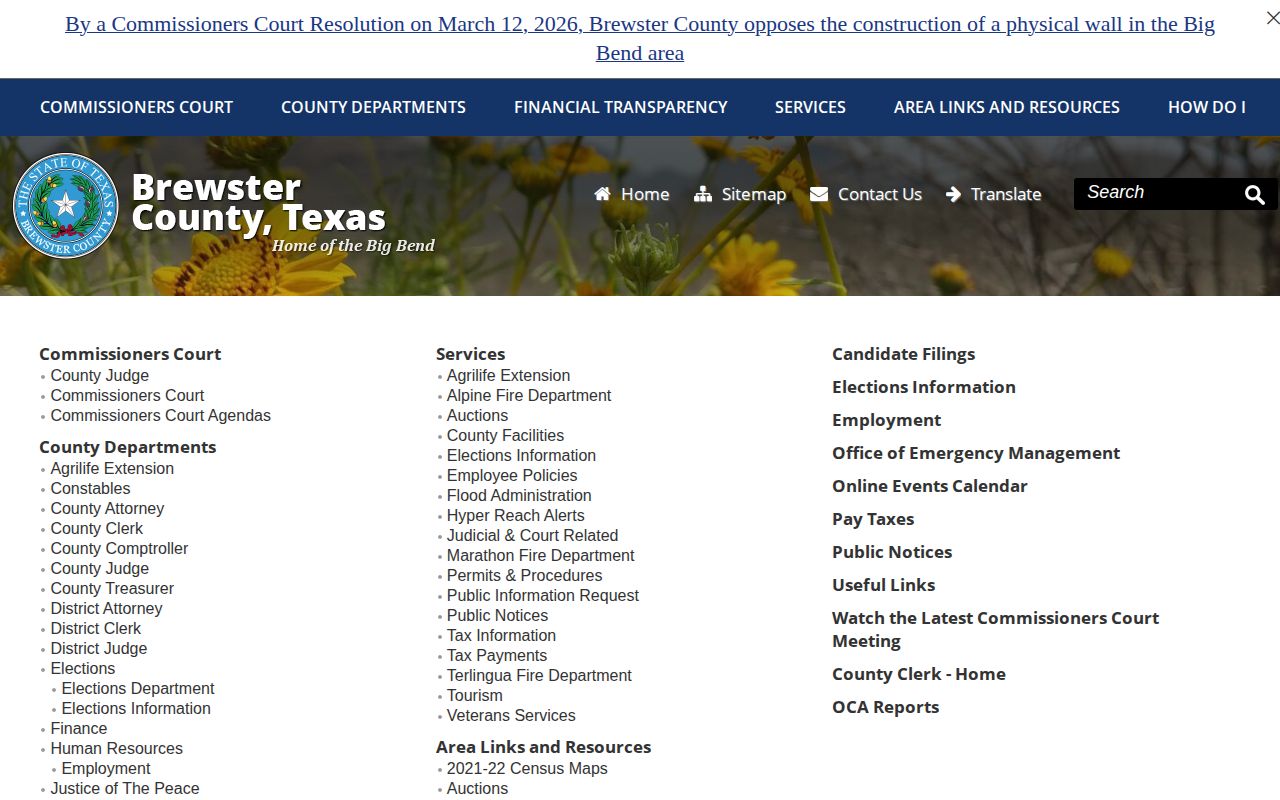
The sitemap capture supports the absence finding; it does not prove any individual person's release or custody status.
How to Check Brewster County Three-Day Releases
A three-day lookup should reconstruct events in order. This method is slower than browsing a feed, but it gives a clearer answer because it separates a community release from a transfer and connects the jail exit to a court or agency record.
- Write down the exact 72-hour period, including the start and end dates. Use it consistently in each inquiry.
- Call Brewster County Jail at 432-837-6200 ext. 5541 with the person's full name, spelling variants, approximate booking date, and date of birth when needed.
- Ask whether the person left the facility during that period and whether the exit was a release to the community or a transfer.
- Check the proper court docket and obtain the filed bond order, dismissal, judgment, sentence, commitment, or release instrument. A calendar entry is only a schedule.
- Send a focused public information request for each release, bond-out, discharge, transfer, or custody-termination record in the defined range.
- Follow the named receiving agency when the jail record reports transfer rather than community release.
The Brewster County 24-hour release process is better for a same-day question. The three-day approach is designed for a wider period and should retain the date and source of every observation.
Note: A narrow three-day request is easier to identify and less likely to be mistaken for a current-roster inquiry.
Brewster County 72-Hour Release Record Fields
No online columns can be promised because the county publishes no feed. Instead, ask for the fields that distinguish the person, the jail stay, the exit event, and what happened next. Texas's permanent jail-register schedule supplies a minimum baseline, while the more detailed incarceration file may contain booking, transport, transfer, release forms, and court orders.
| Requested field | Why it matters in a three-day review |
|---|---|
| Name, aliases, and gender | Separates people with similar names and ties the entry to the right identity. |
| Intake or booking number | Distinguishes one confinement episode from an older or later stay. |
| Booking date and time | Shows when the relevant Brewster County custody episode began. |
| Release or transfer date and time | Places the exit inside or outside the requested 72-hour period. |
| Disposition or reason | Separates bond, time served, court release, sentence completion, and transfer. |
| Receiving agency or destination | Identifies continued custody when that information is public. |
| Bond or court instrument | Connects the jail event to the legal action that authorized it. |
The permanent jail register must at least preserve the name, gender, intake number, confinement reason, and release or transfer date. Detailed files have a minimum retention of release or transfer plus two years, though that is not a promise of destruction at the end of that period. A permanent register entry may still confirm an older date when richer paperwork is no longer available.
Read each field as part of a sequence. A county transfer record may lead to a TDCJ current-custody result, a projected date, a later scheduled date, and eventually an incarceration-history response that documents completed release. Each item has its own date and scope. “Projected” is an estimate, “scheduled” reflects planning after paperwork, and neither word confirms that release occurred. The final record must preserve the agency's own terms.
Names alone are weak identifiers across three days of events. Compare the intake number, booking date, court, and committing agency where available. Date of birth may help the custodian distinguish people, but only include identifying data needed for the request. Conflicting identifiers call for agency clarification, not a guess.
Brewster County Weekend Release Reconstruction
A 72-hour span can cross multiple business days, a weekend, or a holiday. That makes it a useful catch-up window, but Brewster County publishes no feed whose timing can be tested against those events. Do not assume that an office closure changes the legal release time, or that a record appears online on the next workday. There is no local online list to refresh.
Build the timeline from records instead. Record the exact physical exit time, the stated disposition, the court action date, and any receiving-agency entry. Those dates may differ without conflict because they document separate steps. A bond order may precede release processing, while a receiving agency may post its own entry later.
For a named person, the broader Brewster County release-record search maps court, TDCJ, notification, and federal channels. Use those routes only when the custody history shows they apply. TDCJ is not the starting point for a county detainee who never entered state prison.
Note: The wider window reduces the chance of overlooking a day, but it does not turn agency silence into proof of release.
Request Brewster County 72-Hour Release Records
The county's Public Information Request page is the formal route. Requests may be emailed to county.judge@co.brewster.tx.us, mailed to Brewster County, P.O. Box 1630, Alpine, TX 79831, Attn: County Judge, or delivered in person at 201 W. Avenue E, Alpine, Attn: County Judge's Office. Questions go to 432-837-6200 ext. 200.
State the full name and enough identifying detail to avoid a false match. Define the start and end of the 72-hour span. Ask for the booking record and any release, discharge, bond-out, transfer, transport, or custody-termination record, including the date and time of exit, disposition, and receiving agency where disclosable. Request an itemized estimate before copies if a charge is expected.
The request may also ask for the bond or court release instrument and the arresting or committing agency. Those details help reconcile the jail exit with the proper case. Keep the wording broad enough to include a transfer, yet narrow enough for the county to locate the record. Asking only for “released inmates” risks a response about a current roster, while asking only for dates can hide continued custody.
Consult the county's submission instructions and request form before sending the request.
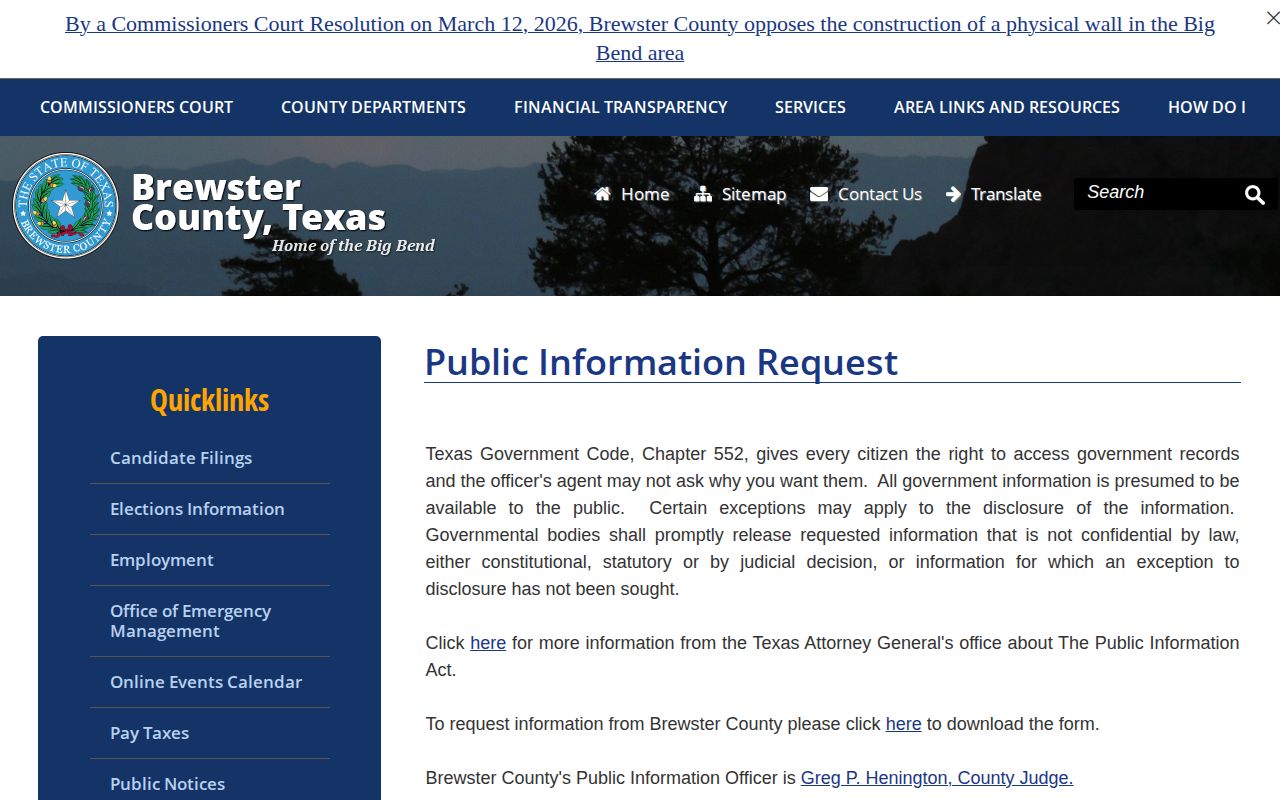
The page identifies the official route but gives no special jail-record fee table, fixed response deadline, or weekend processing promise.
Some fields may be withheld or redacted under law. Juvenile, sealed, confidential, or security-sensitive information can have access limits. A lawful redaction does not erase the rest of the custody event, and it should not be described as proof that no event occurred. Ask whether segregable public portions can be released.
What a Missing Brewster Release Entry Means
There can be no missing entry from an official Brewster County 72-hour feed because the county does not publish one. That distinction prevents a common error: treating absence from an unofficial or current-custody page as evidence that a person left during the last three days.
A released person often drops out of a live jail roster. Yet Brewster County offers no official roster to observe that change. Direct jail confirmation can answer whether the person remains at the facility. The release packet and court instrument then show why the custody episode ended. If a transfer occurred, the receiving system completes the chain.
| Observed fact | Safe conclusion |
|---|---|
| Jail confirms person is still held | The person remains in Brewster County physical custody. |
| Jail says person is no longer there | The person left that facility; destination still needs confirmation. |
| Release record says bond or court release | County jail custody ended under that stated disposition. |
| Record says transferred | Custody continued with the receiving authority. |
Brewster County Transfers Within Three Days
Brewster County Jail can hold more than county criminal defendants. An official U.S. Marshals Service detention agreement makes federal custody at the county building a documented local possibility. State commitments can lead to TDCJ, another county may become the next custodian, and an immigration handoff may require the ICE route.
Follow the wording in the county record. Search TDCJ when it names a state transfer. Use the federal court or USMS path for federal pretrial custody and the BOP locator if the person later enters BOP custody. Use ICE's locator and agency follow-up for an immigration transfer. None of these systems proves the status of a different custodian.
The most useful three-day request asks for “release disposition or reason and receiving agency or transfer destination, where disclosable.” That phrasing reaches beyond the date and answers whether the person returned to the community or simply changed custody.
Post-release supervision is another distinct status. Parole or mandatory supervision can move a person from state prison into supervised community status, while probation generally follows a court order and is handled through the local community-supervision system. Neither should be inferred from silence in a county jail inquiry. The court disposition, TDCJ history, and applicable supervision agency must support the label.
Note: Preserve the words “released,” “transferred,” and “discharged” exactly because each term answers a different custody question.