
Brewster Projected Versus Actual Release
The Texas Department of Criminal Justice, or TDCJ, defines a projected release date as the date its Classification and Records Office calculates for a prisoner to leave incarceration if parole does not occur first. The offense, offense date, sentence, legal eligibility, and time credits all affect that estimate. It is not a court-certified discharge date. It also does not prove the person walked out of a unit on that day.
A scheduled release date is more concrete but still prospective. TDCJ explains that, after a release certificate reaches Classification and Records, staff audit the case and may post a scheduled release date and scheduled release location. The agency warns that this date may change without notice, even on the listed day. An actual release is a completed custody event shown by an incarceration history, release certificate, jail release form, or another agency record.
A Brewster County Jail detainee awaiting trial is different. There may be no sentence from which to calculate an end date. Bond, dismissal, a new court order, a detainer, or transfer can control the exit. Ask the jail and the court about the actual legal event instead of applying a TDCJ formula to a local case.
Find a Brewster Projected Release Date
Begin with the place that has legal custody. The TDCJ Inmate Information Search covers people currently incarcerated in a TDCJ facility. It does not serve as a history of everyone discharged from prison, and it does not cover a person who only spent time in Brewster County Jail. Use an identifier when possible because the form requires an exact last-name match.
- Classify the case. Determine whether the person is in Brewster County Jail, a TDCJ prison, or another system. A county booking alone does not make someone a state prisoner.
- Search current TDCJ custody. Enter a TDCJ number, SID number, or the required name fields. Compare the conviction county, offense, and identifiers before opening a result.
- Read the label exactly. “Projected Release Date,” “Scheduled Release date,” and a parole decision describe different stages. Preserve the wording and date seen.
- Use local records for county custody. Call Brewster County Jail and check the sentencing court for a bond order, sentence, dismissal, commitment, or transfer order.
- Confirm the outcome. After the date passes, obtain the release event or incarceration history. A missing search result alone proves nothing.
The public TDCJ search says its information is at least one day old and is updated on working days. It also advises relatives to call the unit before traveling for pickup. Data lag, a spelling mismatch, or custody in a different system can all produce an unhelpful result.
A county court record can answer a different part of the question. The filed bond order, judgment, sentence, dismissal, or commitment states the legal authority, while the jail record shows what happened to physical custody. Those dates may not match. An order can be signed before staff complete release processing, and a person can remain held under another case or agency detainer after one matter ends. Request the actual instrument instead of relying on a court-calendar entry, which shows scheduling but does not prove a release.
Brewster Release Search Fields
The state form offers several ways to narrow a current-prison search. The strongest route uses a unique number. A name search needs care because exact spelling can hide a valid match or return more than one person.
| Search field | How it helps |
|---|---|
| TDCJ number | Seven-digit state prison identifier and the most direct match. |
| SID number | Texas state identification number used to distinguish records. |
| Last and first name | Last name must match exactly; at least a first initial is required. |
| Gender and race | Filters that help separate similar names but do not replace an identifier. |
| Detail labels | Location, offenses, projected date, and sometimes scheduled date or location. |
Match the record against non-sensitive facts already known, such as conviction county and court. Do not choose the most plausible result when identifiers conflict. Agency confirmation is the safer next step.
The successful manifest image below shows TDCJ’s official definition source. Review the TDCJ Definitions and Acronyms page before interpreting a projected date.
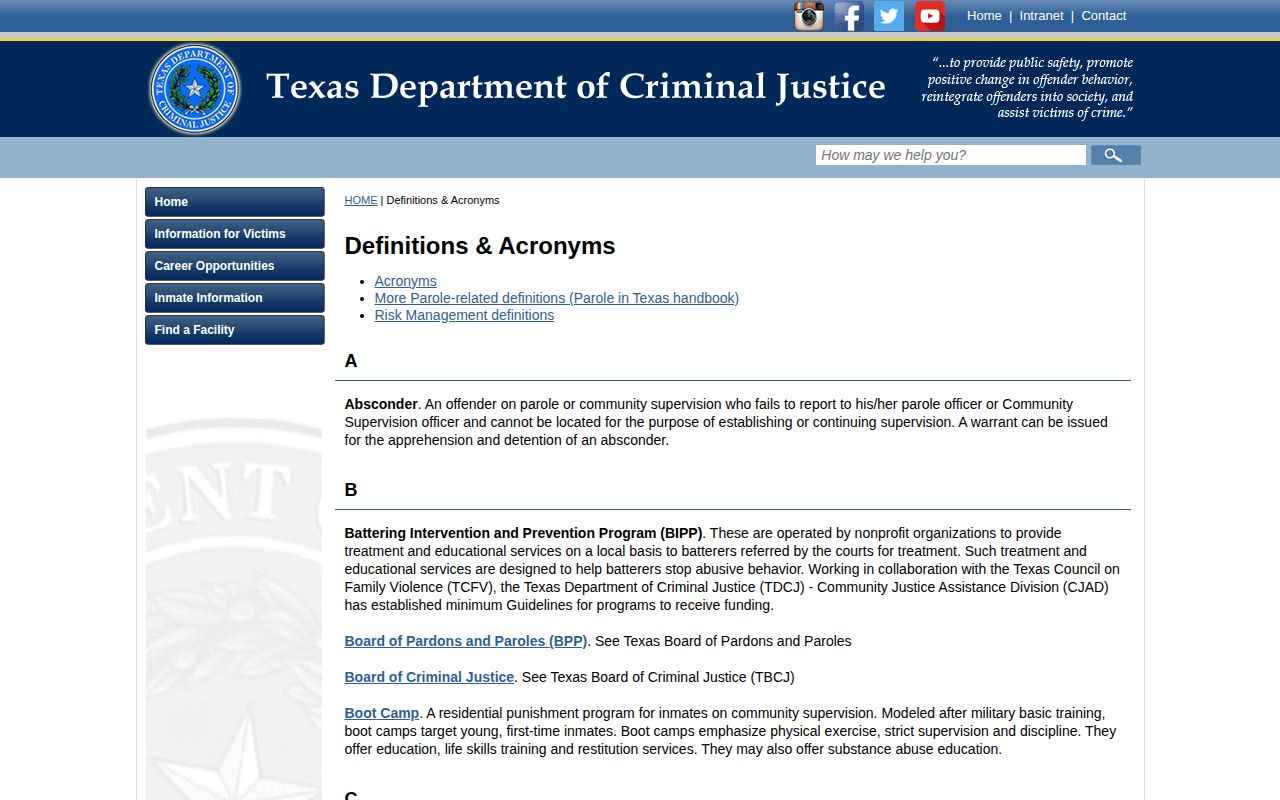
The definition ties the estimate to state classification records and confirms why it should not be recast as an accomplished Brewster County release.
Texas Credits Shape Projected Release
Texas Government Code Chapter 498, especially Section 498.003, governs good-conduct time through classification and qualifying participation. Credits may affect eligibility and projected-date calculations. They do not grant parole. Discipline or a change in classification can alter the credit calculation.
Texas has no single rule requiring every prisoner to serve 85 percent of a sentence. Under Government Code Chapter 508, parole eligibility depends on the offense and other facts. Section 508.145 contains different formulas, including the general rule based on calendar time plus good-conduct time and stricter calendar-time rules for listed serious offenses. Section 508.149 lists convictions that are not eligible for mandatory supervision.
- Flat time
- Actual calendar time served.
- Good-conduct time
- Credit used in classifications and eligible calculations, not a guarantee of release.
- Parole eligibility
- The point at which the Board may consider release, not the day release must occur.
- Mandatory supervision
- A statutory form of supervised release that remains subject to eligibility rules and, for some cases, Board approval.
For an eligible offense committed before September 1, 1996, TDCJ describes the projected date as the point when flat time plus earned good time equals the sentence, unless parole comes first. For later eligible offenses, the Board must also approve discretionary mandatory supervision. In an ineligible case, the projection ordinarily points to maximum expiration unless parole occurs first.
Why Brewster Release Dates Change
A date moves because the legal and custody facts move. The table separates common causes so a changed screen is not mistaken for an agency error.
| Factor | Possible effect | Best confirmation |
|---|---|---|
| Credit or classification change | Recalculation can move a projected date. | TDCJ Classification and Records information. |
| Parole action | Approval can permit earlier processing; denial can move projection toward maximum expiration. | Board result plus TDCJ release record. |
| Detainer or hold | Departure from one place may become transfer to another agency. | Holding and receiving agencies. |
| Court order | A changed sentence, bond order, dismissal, or commitment can alter the custody path. | Filed court order and clerk record. |
| Records audit | A scheduled date may change as staff verify the release certificate and case. | TDCJ unit or records office. |
Parole approval is not the same as physical release. Likewise, transfer out of Brewster County Jail is not always return to the community. The county jail has a documented federal detention relationship, so the receiving agency and disposition matter when a person leaves the local building.
A favorable Board vote can be followed by release-plan review, certificate processing, and the records audit described by TDCJ. A parole date therefore belongs in a chain of evidence, not at the end of it. If the Board denies discretionary mandatory supervision, TDCJ may recalculate the projected date toward maximum expiration. If it later approves release, the agency may move the date forward to allow processing. Each change should be recorded with its source and observation date.
Request Brewster State Release History
A person who completed a TDCJ term may disappear from the current-only search. TDCJ’s email information route is the documented fallback. Send the full name and seven-digit TDCJ number to pia@tdcj.texas.gov. If that number is unknown, include the exact date of birth, or approximate age and county of conviction. Put the person’s name in the subject line and state what is needed.
Ask for incarceration history and the release or discharge date and type. TDCJ lists current incarceration information, prior confinement history, conviction details, and projected release date among available categories, but it does not promise every field in every response. This email service has no charge. It is a state-prison route, not proof of bond-out or sentence completion at Brewster County Jail.
The manifest capture documents the official TDCJ email-information instructions used when the live locator no longer returns a released person.
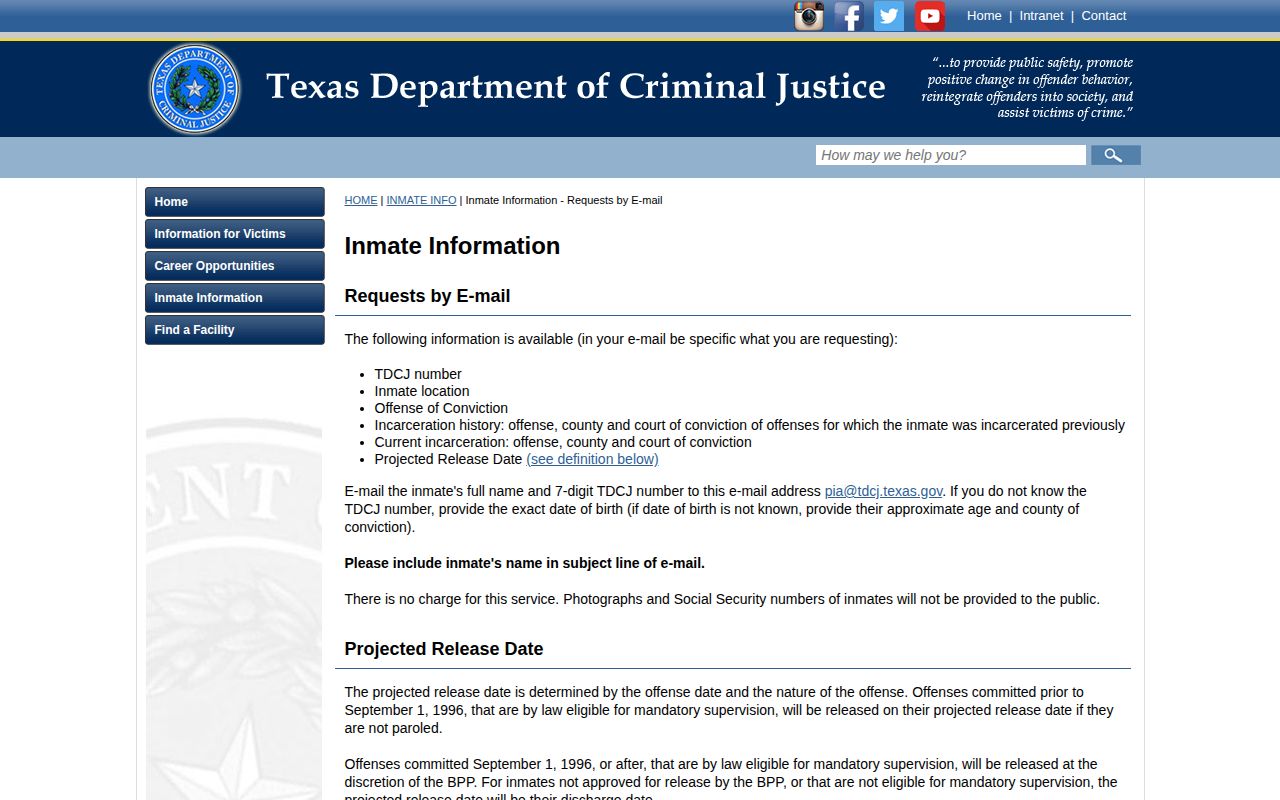
That channel lets a requester seek durable state incarceration history without treating an empty current-custody result as a discharge record.
Read Brewster Release Records in Sequence
A reliable timeline often needs more than one record. A Brewster County jail entry may first show commitment or later transfer to TDCJ. While the person is in state prison, the public TDCJ detail may display a projected date. A Board record can then show a vote about parole or discretionary mandatory supervision. After custody ends, an incarceration-history response or release certificate may document the completed event. Each source answers a different question.
Keep the terms in their original order. “Transferred” means the person left one custodian and entered another. “Eligible” means a legal threshold for consideration has been reached. “Approved” records a favorable decision but may still precede release-plan review, certificate processing, and the records audit. “Scheduled” identifies a planned event that can change. “Released” or “discharged” should be used only when a completed-event record supports it. Converting an earlier stage into a later one can produce a false release date.
Dates also need source labels. Note when the offense occurred, when the sentence began, the date the portal was checked, the exact projected or scheduled date displayed, the Board action date, and the final release date when confirmed. The offense date matters because Texas mandatory-supervision rules distinguish cases before and after September 1, 1996. The observation date matters because TDCJ says its public information is delayed and updated on working days.
When identities are similar, compare the TDCJ or SID number, conviction county, offense, and court. An exact-last-name search can miss a person after a spelling variation, while a common name can return several records. If key identifiers conflict, preserve the ambiguity and ask TDCJ or the record custodian. Do not merge two people’s dates into one apparent timeline.
Confirm Brewster County Actual Release
For county custody, contact Brewster County Jail at 432-837-6200 ext. 5541 and ask two questions: whether the person remains there, and whether the recorded exit was community release or transfer. For durable proof, use Brewster County’s Public Information Act route and request the jail-register entry, booking-out or release sheet, release date and time, disposition, and receiving agency where public.
For a state prisoner, save the exact projected or scheduled label, then confirm the past event through TDCJ history or a release certificate. A parole record may show supervised community status, while maximum-expiration discharge means the sentence ended. The VINELink Check page explains Texas notification routes, but an alert is still a prompt to verify rather than a certified release record.
Keep the systems separate. County jail, state prison, federal custody, and immigration custody each have their own record trail. A correct Brewster County projected release date is useful planning data; only a completed agency record establishes what happened.
Public Record Search
Sponsored Results